
Ghost Controls Gate Repair in Multnomah Village: A Homeowner’s Guide
You came home, tapped the remote, and nothing happened. The gate sat there like it was thinking about it. If that’s your Ghost Controls operator, the problem is often not the motor. These systems are built to run on solar and battery power, and in Multnomah Village’s gray winters the charging math works out differently than the install manual assumes. Before you price a new actuator, test the battery. If you’d rather not chase voltage in the rain, call (833) 508-9284.
Why does my Ghost Controls gate die in the winter?
Ghost Controls operators are sold on the idea of running indefinitely on a solar panel. That idea holds well in a sunny climate. In Multnomah Village, from roughly November into March, the panel gets a fraction of the direct sun it needs, while the battery still has to carry every open and close. The result is a slow discharge that looks exactly like motor failure: the gate slows, creeps partway, then stops. Owners see a dead gate and assume the actuator is gone. Most of the time it’s a battery management issue in a low-light season.
Here’s what a voltage check actually tells you before you touch any hardware:
- Resting voltage below the operator’s low-battery threshold: the controller is in fault, not broken. Charge or replace the battery first.
- Battery holds charge but the gate still stalls: look at the panel angle, shade from trees, and any corrosion at the panel terminals.
- Voltage collapses under load only: the battery has aged out and can’t deliver start-up current, even if it reads fine at rest.
A Ghost Controls linear actuator that’s actually failing will usually show resistance or noise as the rod travels, not just a dead stop. Testing voltage first saves you from buying a motor you didn’t need.
What are the Ghost Controls DIP switch settings that cause random behavior?
Ghost Controls control boards use DIP switches to set things like operating mode, obstruction sensitivity, and open/close behavior. Those settings live in the controller’s memory, and after a real power interruption (a battery disconnect, a dead battery swap, or a solar controller reset) they can come back wrong. The gate then does things that look random: opening when it shouldn’t, reversing halfway, ignoring a safety edge. It’s not random. The switch bank is misconfigured.
If your gate started acting odd right after a battery change or a power outage, check the DIP switches against the installation sheet before you assume a board fault. Owners often don’t have that sheet anymore, which is where a technician who works these systems regularly earns the visit. We work on the gate you already have, and we’ll walk the switch bank and the wiring harness together rather than guess.
Why do Ghost Controls actuators bind at the rod?
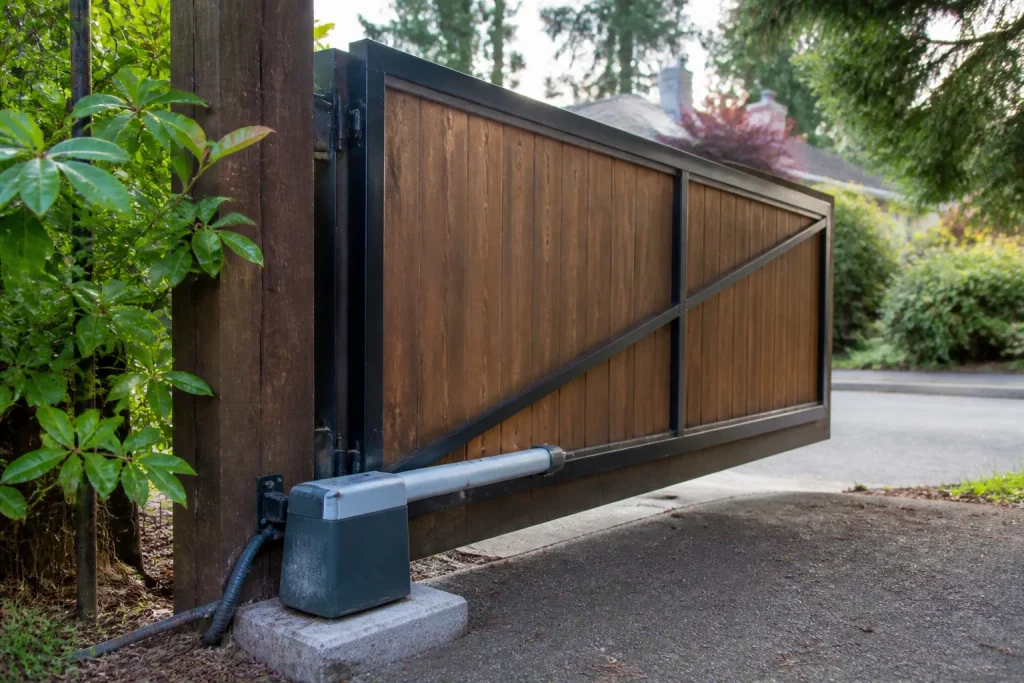
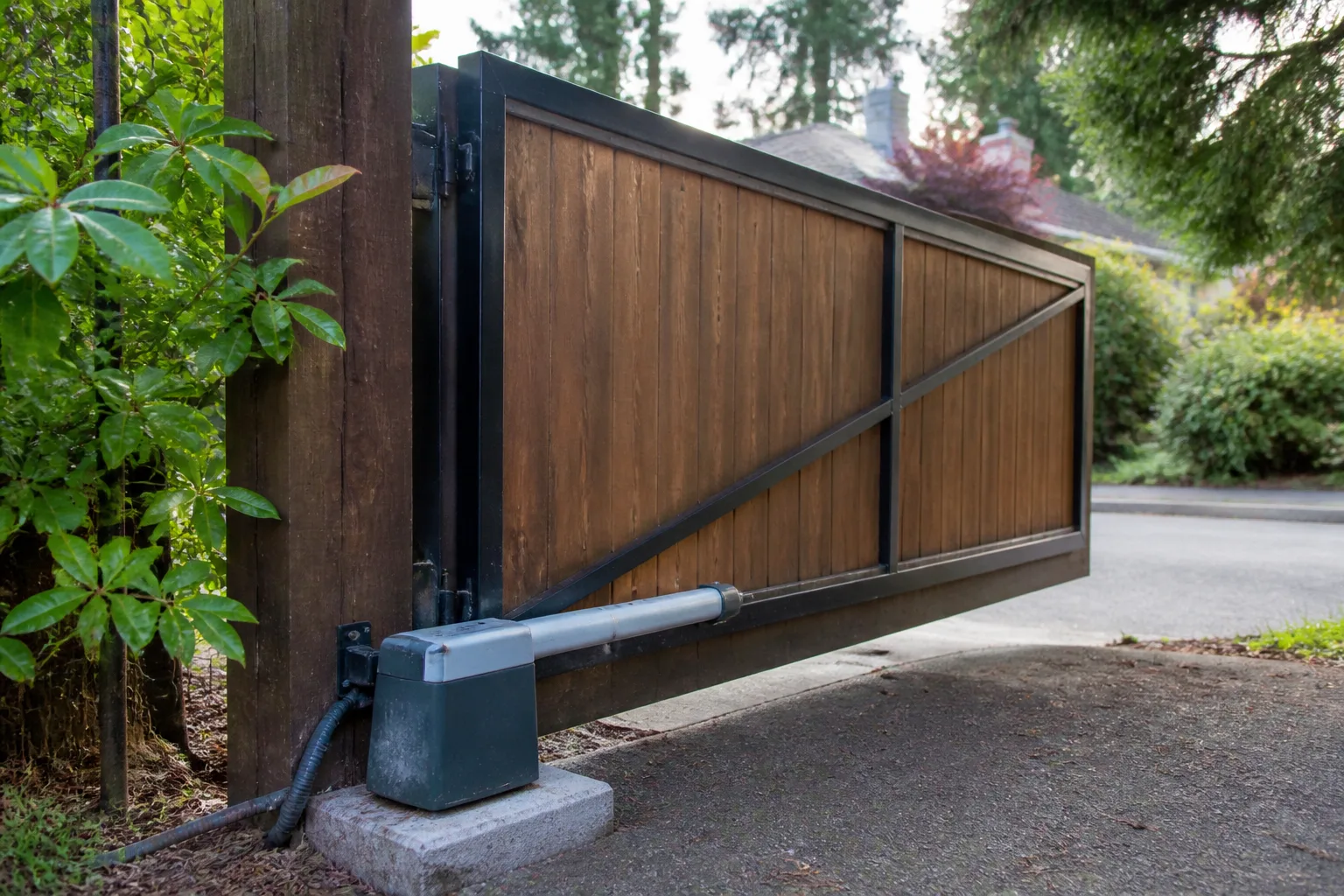
Ghost Controls uses linear actuators, and a linear actuator is far more sensitive to gate alignment than a rotary operator. Rotary units have some tolerance built into their geometry. A linear rod is pushing a gate along a fixed line through its whole stroke, so a hinge that’s dropped, a post that’s shifted, or a gate that’s sagged slightly out of square will load the rod. Push it long enough and you get binding, then resistance, then a stall or a control-board overload fault.
In Multnomah Village, heavy rain on older wood and metal gates accelerates sag and hinge wear. Here’s how to spot misalignment before it kills the actuator:
- Open the gate by hand through its full travel. It should move smoothly from fully closed to fully open. Any tight spot, catch, or point where it needs a shove means the gate itself is binding.
- Look for a dropped hinge side. A hinge that’s given up a few millimeters throws the whole rod line off.
- Check the post. Ground movement or a loose anchor lets the operator and gate fall out of plane.
- Inspect the rod for scoring, noise, or uneven travel speed.
If the gate doesn’t glide by hand, don’t keep cycling the motor. Fix the alignment first.
Why won’t my remotes pair with a Ghost Controls gate?
Ghost Controls receivers aren’t standard rolling-code systems, so the usual factory-reset-and-relearn dance from a DIY video often won’t work here. The receiver expects its own pairing sequence, and older remotes or cloned units may simply not talk to a newer board. When the operator resets, or the board is replaced, the paired remotes in the car end up locked out.
Before you buy new remotes, rule out the simple stuff: fresh remote battery, the receiver in learn mode, and the remote matched to the protocol the board actually expects. If a keypad or entry system is also on that gate, the pairing order matters. Access control on a Ghost Controls gate is its own job, and it’s one of the things we handle in-house, from keypad programming to commercial multi-user entry.
Whether your opener is a Ghost Controls or a LiftMaster, the receiver logic is the part most owners get wrong. That’s usually a ten-minute fix for someone who knows the brand.
What’s safe to fix yourself and what isn’t?
Some Ghost Controls fixes are genuinely reasonable for a careful homeowner. Others aren’t, and the line falls at the wiring harness and the high-current side of the controller.
Generally fine to handle yourself:
- Cleaning the solar panel and trimming shade that hits it during the day.
- Checking battery voltage at rest and under load with a meter.
- Checking gate alignment by hand and tightening loose hinges or anchors.
- Swapping a remote battery and re-pairing a single remote using the installation sheet.
Leave to a technician:
- Any work inside the controller’s proprietary wiring harness and terminal block.
- Battery bank swaps on a solar system where the charge controller has to be re-set.
- DIP switch reprogramming when you don’t have the reference sheet.
- Anything touching the 120V power feed or an access-control junction.
That last category isn’t a nag. Line voltage and a high-current battery bank can hurt you, and the controller expects a specific harness configuration. If you’re past the simple checks, that’s the point to call a pro.
When should you call a technician instead of troubleshooting?
Call when the gate has stopped responding after you’ve tested the battery, checked alignment by hand, and confirmed the remotes are paired. Also call if the controller fault comes back after a reset, if the actuator is noisy or stalling mid-travel, or if your solar system isn’t holding charge even in decent light. Those point to components or settings that need a brand-familiar set of eyes.
We train on Ghost Controls alongside FAAC, BFT, and Linear, and the reason that matters is diagnostic honesty. A technician who only knows one platform tends to sell you a new system when the old one needs a battery and a switch reset. Because we’re trained across competing brands, we can tell you whether a repair or an upgrade is the right call, and we mean it.
Our technicians have up to 14 years of experience. We answer 24/7, and fast dispatch runs from 7am to 7pm, Sunday through Friday. Same-day service is available when the work suits it, and the price is quoted and agreed before any work starts. The estimate is free.
If you need broader help with the gate itself, our gate repair handles the mechanical side, and gate motor & opener covers the operator when a battery swap won’t do it.
Related services in Multnomah Village
A Ghost Controls issue is often one part of a bigger gate picture. If you’re weighing a repair against a fresh system, our gate installation lays out what a new build involves. For the full range of what we do, start with Gate Repair Multnomah Village.
What happens when you call
- 1
A real person answersNo phone trees – you reach a local pro.
- 2
You get an upfront price rangeHonest numbers before anyone is dispatched.
- 3
A background-checked tech heads outLicensed & insured, dispatched right away.
- 4
You approve before work beginsNothing starts until you say go.
The Bottom Line
- In Multnomah Village, a Ghost Controls gate that quits in winter is usually a solar charge deficit, not a dead actuator. Test the battery first.
- Odd behavior after a power interruption is often a DIP switch that reset. Check the switch bank before replacing a board.
- Linear actuators bind when the gate drops out of alignment. If it doesn’t move smoothly by hand, fix the gate before the operator.
- Pairing failures are specific to the Ghost Controls protocol, not generic rolling-code.
- Battery checks and hinge tightening are DIY-safe. The wiring harness, charge controller, and line voltage are not.
If you’re in Multnomah Village and need help, Gate Repair Multnomah Village offers free estimates. Call (833) 508-9284. We answer 24/7, with fast dispatch from 7am to 7pm, Sunday through Friday.
Frequently Asked Questions
Cost depends on what’s actually wrong, so there’s no single number. A battery replacement or DIP switch reset is a small job; an actuator swap or controller repair is larger. The price is set per job by a written estimate, quoted and agreed before any work starts. Call (833) 508-9284 for a free estimate.
Same-day service is often possible depending on scheduling. We answer 24/7 and run fast dispatch from 7am to 7pm, Sunday through Friday. Call (833) 508-9284 and we’ll find the earliest opening.
We work on the gate you already have, across brands like Ghost Controls, LiftMaster, FAAC, BFT, Linear, and others. If your system isn’t Ghost Controls, we can still diagnose and repair it. Call (833) 508-9284 to confirm your model.
Simple checks are fine to do yourself: battery voltage, panel cleaning, and hinge alignment by hand. Anything in the wiring harness, the charge controller, or the 120V feed needs a technician familiar with the brand. When you’re past the easy checks, call (833) 508-9284.
Written by the team at Gate Repair Multnomah Village.
Need Gate Repair Help?
Call Gate Repair Multnomah Village - the local pro we connect you with is licensed and insured, here with fast help in Multnomah Village.
(833) 508-9284